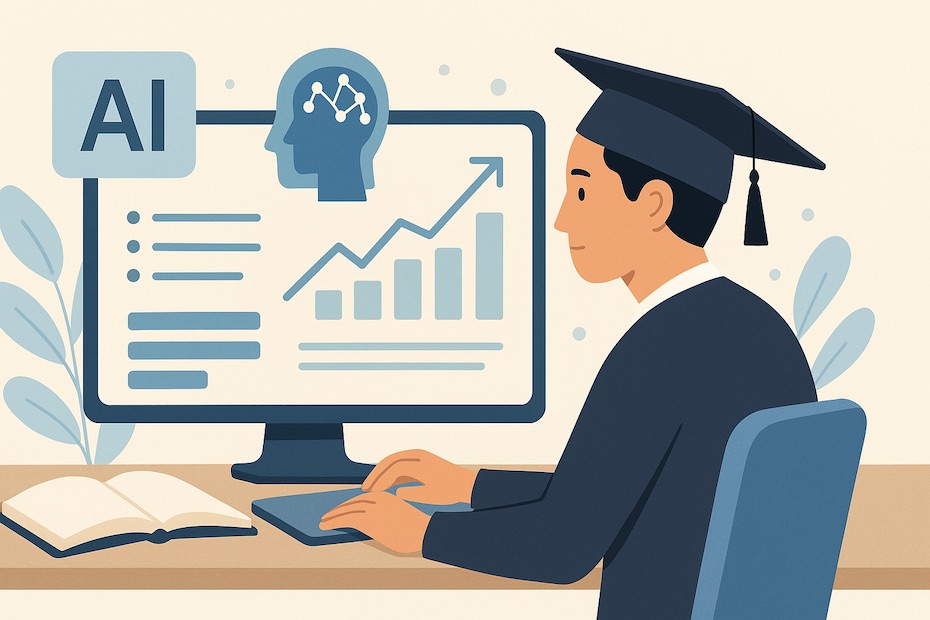
AI is transforming higher education by personalizing graduate learning, automating routine academic tasks, and reshaping the roles of educators into mentors and guides.
In this article, you’ll learn how artificial intelligence enhances graduate education through adaptive systems, real-world use cases, institutional adoption, and preparation strategies. You’ll also see what challenges exist and how you can position yourself to thrive in an AI-driven academic environment.
What are AI-powered personalized learning systems?
AI-powered personalized learning systems dynamically adjust instruction based on your strengths, weaknesses, and pace. These systems analyze performance data and deliver targeted content.
Adaptive learning platforms like Carnegie Mellon’s Algebra Tutor demonstrate how intelligent tutoring can provide individualized assistance at scale. By tracking your progress, these systems highlight gaps in understanding and provide focused exercises. Graduate students benefit because the instruction is responsive and efficient, often accelerating mastery.
Universities are embedding adaptive systems into learning management platforms. By doing so, they provide students with highly tailored instruction and continuous feedback, which helps maintain engagement in demanding graduate-level work.
Can AI improve student outcomes and efficiency?
Yes. AI significantly reduces study time while increasing effectiveness.
In recent studies, learners using AI tutoring assistants reported completing material about 27% faster than peers without such tools. AI also automates grading, feedback, and routine administrative tasks, freeing faculty to dedicate more time to mentorship and discussion. That shift improves outcomes while reducing burnout among educators.
In professional programs like business schools, AI is now used for brainstorming, simulation modeling, and project scoping. This allows you to focus more on strategic thinking and critical reasoning, knowing that lower-level tasks can be supported by intelligent systems.
How do institutions integrate AI into graduate programs?
Graduate programs are increasingly adopting AI across admissions, coursework, and student support.
California State University deployed ChatGPT Edu across 23 campuses, providing adaptive tutoring and research assistance to over 460,000 students. Top business schools including Wharton, Columbia, and Duke have launched AI-focused coursework, embedding it directly into their graduate curricula.
Universities worldwide are expanding AI initiatives. Institutions in India, for example, are using AI-driven personalized learning as a way to tackle graduate employability challenges. Faculty readiness, digital infrastructure, and curriculum design are key components in successful adoption.
Will AI replace human educators?
No—AI complements educators but does not replace them.
AI delivers scalable feedback and tutoring, but graduate students still need mentors who guide discussions, cultivate critical thinking, and support personal development. Educators remain essential in facilitating collaborative learning and contextualizing knowledge.
Students consistently report valuing social and emotional guidance from instructors. AI frees up instructor time, but the mentoring, coaching, and professional advising functions remain human-driven. Expect your professors to shift from lecturing toward guiding, interpreting, and coaching.
What challenges does AI in graduate learning raise?
Adoption comes with challenges: data equity, ethics, faculty readiness, and academic integrity.
Personalized AI systems risk reinforcing bias if not carefully monitored. Privacy concerns are also significant, as AI depends heavily on student data. Without proper governance, institutions may expose sensitive information.
Faculty training remains uneven. Many professors lack familiarity with AI tools, making integration inconsistent. Additionally, academic integrity policies must evolve. Some institutions now design AI-inclusive assessments, while others impose strict restrictions. As a graduate student, you should anticipate new expectations around using AI responsibly.
How should students prepare for AI-enhanced graduate learning?
Preparing for AI-driven graduate programs requires building digital fluency and adjusting how you engage with faculty.
You should develop AI literacy—learning how to use tools not just for quick answers, but for refining your reasoning and strengthening your analysis. That means practicing with generative tools in ways that enhance, not replace, your own work.
Seek programs that explicitly integrate AI into curriculum design and feedback systems. When studying, leverage dashboards and analytics to monitor your progress. Pair these tools with meaningful faculty mentorship, since professors will increasingly focus on helping you frame ideas and synthesize information.
How is AI shaping graduate learning?
- Personalized adaptive learning and tutoring
- Faster mastery and efficient study time
- Faculty shift from lecturers to mentors
- Institutions integrate AI in admissions, curriculum, and support
In Conclusion
AI is reshaping graduate education into a more personalized, efficient, and mentorship-driven model. You can maximize the opportunity by building AI literacy, choosing programs that embed AI, and working with faculty who elevate reflection and synthesis. That preparation ensures you stay competitive in the next era of higher learning.

Rick Blosser is Managing Partner of Pathfinder Wealth Advisors, an independent RIA and multi-family office. With 30+ years in wealth management, he advises high-net-worth families on investment strategy and planning, drawing on prior leadership roles at Morgan Stanley, UBS Private Wealth Management, and Wells Fargo Advisors.