
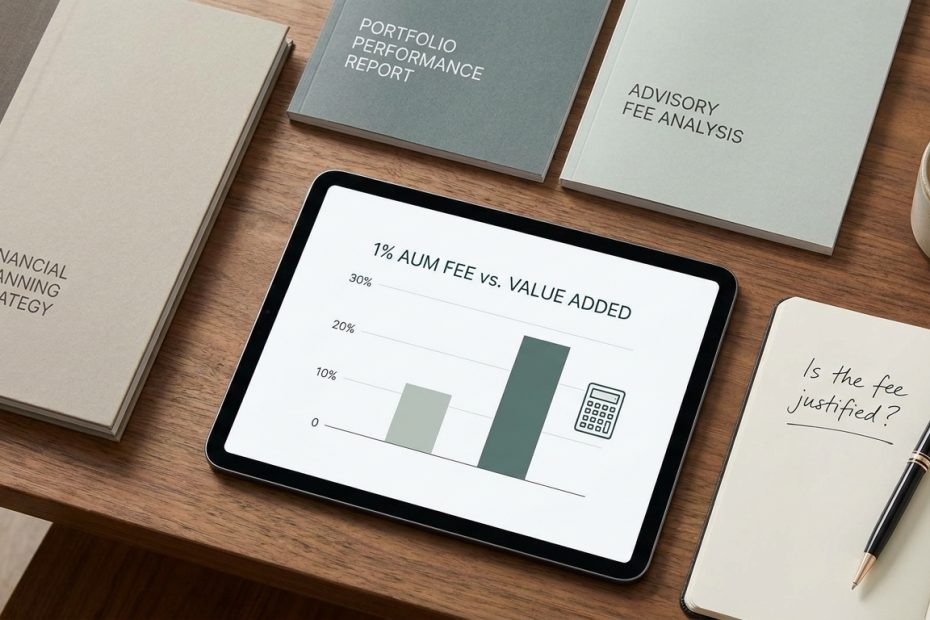
A wealth management fee of 1% is worth paying only when the advisor delivers clear value beyond basic portfolio management: tax planning, retirement income strategy, estate coordination, behavioral coaching, and ongoing financial decisions. It is usually too expensive when the service only puts you into low-cost funds you could manage yourself.
This is the exact concern investors raise on Reddit: “Is it worth the typical 1% annual fee?” The right answer is not anti-advisor or pro-advisor. The right answer is whether the work being done justifies the ongoing cost, especially when low-cost ETFs and index funds are widely available.
What Is a 1% Wealth Management Fee?
A 1% wealth management fee usually means the advisor charges 1% of the assets they manage for you each year. FINRA explains that advisory account fees are often charged as a percentage of total assets, commonly on a periodic basis, and they apply regardless of whether you buy or sell securities.
That structure is called an AUM fee, or assets under management fee. If the account value grows, the advisor’s dollar fee grows too. If the account value falls, the fee usually falls in dollar terms, but the percentage rate may stay the same unless your agreement has breakpoints.
The important point is simple: 1% is not a trading fee. It is an ongoing advice and management fee. FINRA also states that the exact services and fees depend on the agreement you sign with the brokerage firm or investment adviser, so the contract matters as much as the headline percentage.
Why Are Investors So Skeptical About the 1% Fee?
Investors are skeptical because many already own simple, low-cost ETF portfolios and do not see why an advisor should take 1% every year to manage something basic. In the Reddit thread behind this article topic, the investor said they used a small basket of low-cost ETFs and asked whether big-bank wealth management delivered market-beating results, exclusive access, or enough value to justify the typical 1% annual fee.
The comments show the main buyer fear: paying for status, branding, or generic portfolio allocation instead of real planning value. Some commenters said wealth management can make sense for complex tax planning, estate planning, business assets, bespoke lending, and complicated financial lives. Others said a simple ETF investor may not need that level of service.
That skepticism is rational. ICI reported that in 2025, the average expense ratio for index equity ETFs was 0.14%, and the average expense ratio for index bond ETFs was 0.09%. Those numbers are far below a 1% advisory fee, so investors have every reason to ask what they receive in return.
What Should You Get for a 1% Wealth Management Fee?
For a 1% wealth management fee, you should get more than investment selection. You should get a written plan, retirement income guidance, tax-aware decisions, risk management, estate coordination, cash-flow planning, and ongoing accountability.
CFP Board’s consumer site describes financial planning as a process that starts with assessing your situation, developing goals, building recommendations, putting the plan into action, and monitoring progress. It also lists planning services across budgeting, business succession, estate planning, inheritance, insurance, investment planning, retirement income management, small business planning, and tax planning.
That matters because portfolio management alone has become cheaper. A 1% advisor needs to prove value through financial coordination. If the service is only “we pick funds and rebalance,” the fee faces direct competition from index funds, target-date funds, robo-advisors, and advice-only planners.
A strong wealth manager should also define who does what. CFP Board notes that implementation and monitoring depend on the planning agreement, and clients need to know what the planner handles and what remains the client’s responsibility.
Use this checklist before paying 1%:
- The advisor gives a written financial plan, not only an investment proposal.
- The advisor explains all-in costs, including advisory fees and fund costs.
- The advisor reviews taxes, retirement income, insurance, estate documents, and cash flow.
- The advisor can explain when the fee may not be worth paying.
- The advisor gives clear responsibilities, review dates, and service deliverables.
When Is a 1% Wealth Management Fee Worth It?
A 1% fee can be worth it when the advisor helps you avoid large planning mistakes, keeps you disciplined, coordinates complex money decisions, and gives you ongoing execution support. The fee has a stronger case when your financial life is too complex to manage through a basic ETF portfolio.
Vanguard’s Advisor’s Alpha research estimates that advisors can add “about 3%” in net returns through relationship-oriented services, including wealth management and behavioral coaching, with actual value varying by client circumstance. Vanguard also assigns high value to behavioral coaching, with its research citing 150 basis points from that category in one Canadian Advisor’s Alpha paper.
That does not mean every advisor earns 1%. It means the value comes from planning behavior, risk control, tax-aware choices, spending strategy, and disciplined execution rather than market-prediction claims. A good advisor is not paid to guess next year’s top stock. A good advisor is paid to keep your full financial life moving in the right direction.
Morningstar’s “Mind the Gap” research also supports the behavior issue. It says the gap between investor returns and reported fund returns is tied to timing decisions, investment costs, tax efficiency, cash-flow timing, sequence of returns, and asset size.
When Is the 1% Fee Too Expensive?
The 1% fee is too expensive when you receive ordinary fund selection, unclear planning, vague performance promises, high-cost products, or limited access to the advisor. It is also too expensive when the advisor cannot explain the services included in writing.
Reddit comments repeatedly point to this concern. In one personal finance thread, commenters pushed the user toward fee-only advice, flat-rate planning, or hourly planning rather than a percentage-based investment management fee. One commenter said they would not pay a percentage to manage investments, and another pushed the idea of a flat one-time planning fee instead of continuous active management.
The UKPersonalFinance thread raised the same issue. One commenter said they left a wealth manager charging 1% for “not doing a whole lot,” and another said wealth management may be useful for unusual tax circumstances or higher asset complexity, but less useful when the service only places money into a tracker fund.
The warning sign is not the 1% fee by itself. The warning sign is a fee without a service list. Ask for the annual service calendar, the planning scope, the investment method, the tax review process, the meeting cadence, and the total expected cost.
How Does a 1% Fee Compare With Low-Cost ETFs?
A 1% advisory fee is much higher than the average expense ratio of many index ETFs, so the advisor has to deliver planning value beyond the fund cost. ICI reported average 2025 expense ratios of 0.14% for index equity ETFs and 0.09% for index bond ETFs.
This comparison explains the Reddit frustration. A self-directed investor using low-cost ETFs may already have broad diversification at a very low product cost. Paying 1% on top of fund expenses changes the math and raises the bar for service quality.
That does not make every 1% fee wrong. It means the value test should shift from performance chasing to planning output. If the advisor helps with tax-aware asset placement, withdrawal sequencing, concentrated stock, estate planning, business cash flow, retirement income, or family coordination, the comparison is no longer advisor versus ETF. It becomes ETF-only execution versus full financial planning.
Should You Choose Fee-Only, Flat-Fee, or Advice-Only Planning?
A fee-only, flat-fee, hourly, or advice-only planner may fit you better when you want a professional plan but prefer to manage investments yourself. NAPFA says fee-only advisors may be paid hourly, by retainer, as a percentage of assets, or as a flat fee, and it describes fee-only compensation as direct client-paid advice with no commissions.
This matters for DIY investors. You may need a retirement checkup, second opinion, tax-aware allocation review, or estate-document review without turning over your portfolio to an AUM manager. A flat-fee planner can give you paid advice without taking a percentage of your assets each year.
Advice-only planning has gained attention for the same reason. A 2026 Wall Street Journal Buy Side article described advice-only advisors as professionals who guide DIY investors on budgeting, investing, tax strategies, and retirement planning without managing assets or earning commissions; they may charge hourly, project-based, or flat monthly fees.
The model should match the job. Use AUM when you want ongoing management and implementation. Use flat-fee or advice-only planning when you want expert guidance and can execute the plan yourself.
What Questions Should You Ask Before Paying 1%?
Ask questions that expose services, costs, conflicts, planning depth, and accountability. FINRA advises investors to ask what services will be offered, how services differ from the current arrangement, how fees compare, whether a conversion could trigger tax consequences, who will handle the account, and what qualifications they have.
Your questions should be direct. Ask for the all-in annual cost in writing. Ask whether the advisor receives any commission or product-related compensation. Ask whether they use proprietary funds. Ask what tax planning work is included. Ask whether they coordinate with your tax professional or estate attorney.
Then ask the question most investors skip: “What would make this fee not worth paying for me?” A serious advisor should be able to describe the type of client who should not pay 1%. That answer tells you whether they are selling a product or diagnosing your actual need.
Is Big-Bank Wealth Management Worth the 1% Fee?
Big-bank wealth management can be worth it when the bank provides planning, lending, trust coordination, tax-aware support, and service quality you cannot get elsewhere at a lower total cost. It is weak value when the offer is generic allocation, in-house products, vague access, and no clear planning deliverables.
The Reddit investing thread showed strong concern about big-bank incentives. Commenters raised issues around kickbacks, expensive services, high expense ratios, product incentives, and the need to ask how advisors are paid. The same thread also included users who valued private-firm wealth management for wills, legal coordination, taxes, insurance, donor-advised funds, and trusts.
This is why brand name is not enough. A large institution can offer useful capabilities, but it can also sell expensive convenience. A smaller independent advisor can offer better alignment, but only if the planning quality and credentials are strong. The firm type matters less than total cost, service scope, advisor incentives, and fit.
Before choosing a big bank, compare the bank’s all-in cost against fee-only planners, independent RIAs, flat-fee advisors, and advice-only planners. Keep the comparison focused on work performed, not office prestige.
How Do You Decide Whether the 1% Fee Fits You?
Decide by matching the fee to the job. Pay 1% when the advisor manages tasks that are complex, time-sensitive, tax-sensitive, emotionally difficult, or costly to get wrong.
Start with your own behavior. Morningstar says investor return gaps are influenced by timing decisions, costs, tax efficiency, cash-flow timing, sequence of returns, and asset size. If you have a record of chasing returns, panic selling, ignoring taxes, or delaying planning decisions, advisory value may come from discipline as much as technical advice.
Then review complexity. You have a stronger case for ongoing wealth management if you face retirement income decisions, business-owner planning, inherited assets, concentrated stock, multi-account tax planning, estate coordination, trust planning, charitable planning, or family financial decisions. You have a weaker case when your financial life is simple, your portfolio is diversified, and you can follow a written plan without outside pressure.
The clean test is this: can the advisor show the service list, cost, planning value, and ongoing responsibility clearly enough that you would still hire them without any promise of beating the market? If the answer is yes, the 1% fee may be justified. If the answer is no, the fee needs a lower-cost alternative.
Is a 1% Wealth Management Fee Worth It?
A 1% wealth management fee is worth it only when advice covers taxes, retirement income, estate planning, risk, and behavior—not basic fund picking.
Is Wealth Management Worth the 1% Fee?
A wealth management fee of 1% can be worth paying when you receive real planning, disciplined execution, tax-aware guidance, retirement income strategy, estate coordination, and ongoing decision support. It is hard to justify when the advisor only manages a simple portfolio of low-cost funds. Before paying, demand an all-in cost estimate, written service scope, conflict disclosure, and a clear answer to what the advisor will do that you cannot do effectively yourself.

Rick Blosser is Managing Partner of Pathfinder Wealth Advisors, an independent RIA and multi-family office. With 30+ years in wealth management, he advises high-net-worth families on investment strategy and planning, drawing on prior leadership roles at Morgan Stanley, UBS Private Wealth Management, and Wells Fargo Advisors.