Effective note-taking means capturing and organizing information in ways that help you understand it, remember it, and use it later when it counts.
Strong academic performance isn’t just about what you hear in lectures or read in research journals. It’s about how you record, organize, and revisit that information. This article walks you through tested note-taking strategies that work across disciplines—from quick outlines in lectures to structured reviews of dense seminar material.
What Is the Most Efficient Way to Take Notes?
The most efficient method depends on your subject, format, and study goals. If you’re in a fast-paced lecture, structured systems like the Cornell Method help you sort material in real time while setting up your future reviews. In research seminars or case discussions, visual methods like mind maps often help you trace ideas and debates. The key is this: note-taking isn’t about copying information. It’s about translating it into your own language so you can recall it later.
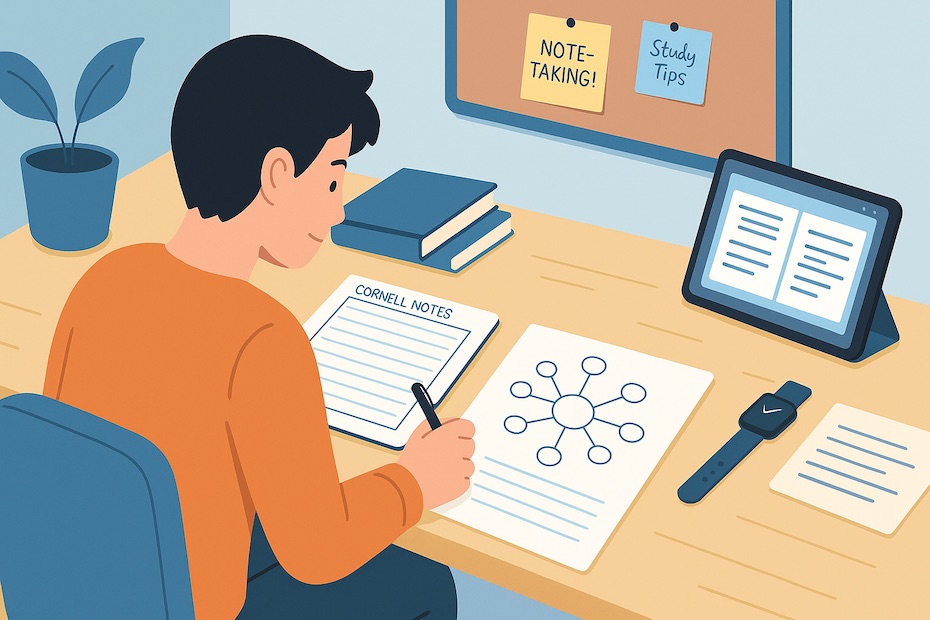
In a typical class, your working memory is under pressure. Writing everything you hear isn’t realistic or helpful. You want methods that allow you to listen, think, and jot down only what matters. Cornell’s layout—notes on the right, prompts on the left, and a summary below—gives you a repeatable format that teaches you to filter and recall. It’s structured but adaptable.
Why You Should Ditch Verbatim Transcription
Typing everything you hear might feel efficient, but it typically leads to shallow retention. Research shows students who write by hand, and particularly those who rephrase as they write, absorb more and perform better in tests. When you transcribe, you don’t engage with the material. You become a stenographer instead of a student.
You don’t need to give up digital tools. Many apps like Notability, OneNote, or GoodNotes now support stylus-based writing and audio syncing. You can sketch concept maps, scribble in margins, or tag key sections for future review—all while staying engaged. The goal is to make your brain do more than just echo back what’s being said.
Cornell Method: Still Relevant?
Absolutely. It’s more than just a layout—it’s a thinking routine. You divide your paper into three areas: a wide section for main notes, a left-hand column for questions or keywords, and a bottom strip for summaries. You take notes during the lecture or reading, add cues shortly after, then write a brief summary to lock in what you learned.
It works particularly well when you’re preparing for quizzes or closed-book exams. The left column becomes your personal flashcard generator. You cover the main section and test yourself using the prompts. You don’t just study harder—you study smarter.
When to Use Mapping and Diagrams
Mapping isn’t about being artistic. It’s about seeing structure. When topics are interconnected—like in psychology, history, or any theory-driven field—mind maps and concept trees help you visualize relationships. You start with a central idea and branch out into subtopics, each linked with keywords, arrows, or color cues.
These methods are useful in research seminars or project meetings, where the conversation is less linear. Instead of forcing your notes into bullet points, you capture movement and connections. Tools like Coggle, MindMeister, and Miro let you map live as the discussion unfolds, especially in collaborative settings.
Outlining, Sentence Method, and Hybrid Strategies
Outline methods are straightforward: hierarchical lists organized by indentation. You get structure, speed, and clarity—ideal for lectures that follow a clear flow. The sentence method takes this further by writing each point as a complete thought on a new line. You end up with compact but comprehensive records of the session.
These styles work best for factual material—STEM lectures, survey courses, or legal briefings. But they also require active engagement. You have to decide where each point fits. Many successful students start with an outline, then color-code or map sections afterward to cement the structure.
Digital Tools: Help or Hindrance?
Used well, digital tools can supercharge your note-taking. The problem isn’t the tech—it’s how you use it. Apps like Notion let you organize lectures, readings, and project notes in one place. You can tag material, embed links, and set up spaced review prompts.
But multitasking is a risk. If you’re switching between Slack, your calendar, and notes during a lecture, you’re not paying full attention. Use Do Not Disturb mode. Close non-essential tabs. Treat your note-taking app like a physical notebook—only better.
Hybrid setups work well for research-heavy students. You might sketch rough notes by hand, scan them into your app, and link them to reference materials or class recordings. This system lets you combine the benefits of analog and digital—retention with flexibility.
Reviewing Notes: The Real ROI
Taking notes isn’t the finish line—reviewing them is. You remember more when you revisit notes within 24 to 48 hours. That’s when your brain starts deciding what’s worth keeping. A quick re-read, summary writing, or quiz session can double your retention rates.
Build a weekly system. Every Sunday, spend 30 minutes scanning the past week’s notes. Turn key points into questions. Tag sections to follow up with professors or peers. Small sessions now prevent cramming later. Use active recall and spaced repetition to turn passive notes into long-term knowledge.
Top Note-Taking Tips That Work
- Use Cornell format for structure and recall
- Write by hand to boost memory
- Map concepts in theory-heavy discussions
- Use outlines for fast-moving lectures
- Digitize only if you stay focused
- Review notes within 48 hours
How to Know What’s Working
If your notes help you teach the material to someone else, they’re doing their job. If you’re reading them and still feel confused, something’s missing. You might need to switch styles—or combine them. A hybrid system could involve outlines during class, mapping after, and Cornell for review.
Ask yourself after each lecture: What’s the one idea I want to remember next week? Write it in the summary. That practice alone improves retention. Over time, you’ll notice patterns in how you process information—and that awareness is a study skill in itself.
In Conclusion
Your notes are more than a memory aid—they’re your personal learning system. Whether you’re using Cornell structure, mapping ideas, or typing organized outlines, your goal is the same: capture meaning, not just words. Choose techniques that match your subjects, stick to a review schedule, and tweak your system based on results. When your notes start teaching you—that’s when they’re working.

Rick Blosser is Managing Partner of Pathfinder Wealth Advisors, an independent RIA and multi-family office. With 30+ years in wealth management, he advises high-net-worth families on investment strategy and planning, drawing on prior leadership roles at Morgan Stanley, UBS Private Wealth Management, and Wells Fargo Advisors.